
Assessment of Accommodations and Support for Sensory Regulation in Autistic People - אבחון התאמות ותמיכה בוויסות חושי בקרב אוטיסטים
In the previous post, we took a closer look at the key aspects of sensory processing and regulation in autistic people.
This time, we will discuss how sensory regulation is assessed and supported in order to improve autistic people’s quality of life.
Assessing the Sensory Profile of Autistic People
Several tools are available for assessing sensory processing in autism:
The Short Sensory Profile (SSP) and Sensory Profile 2 are caregiver or parent report questionnaires designed for children aged 3 years to 14 years and 11 months. They provide a comprehensive picture of how the child processes sensory input in their natural environment, at home or in an educational setting, and how this affects daily functioning.
The Adolescent/Adult Sensory Profile (AASP) is a 60-item self-report questionnaire for individuals aged 11 to 65 years and older. It enables individuals to assess their own sensory preferences, sensitivities, and response patterns, providing important insights into self-regulation and the management of their academic, occupational, and personal lives.
However, researchers caution that caregiver or parent reports may capture only the most extreme or distressing sensory differences and may be influenced by the child’s communication abilities or language level.
This is particularly important for autistic people with minimal spoken language, whose internal sensory experiences may be underrepresented in caregiver or parent reports.
The gap may be even more pronounced among adults, who may mask or compensate for their sensory differences.
A 2017 review found that although growing evidence suggests that sensory symptoms persist into adolescence and adulthood, normative data for older age groups remain limited, and pediatric assessments may not focus on functional outcomes or environments relevant to adults.
In summary, to obtain a reliable and accurate understanding of each person’s individual sensory profile, it is recommended to combine an age-appropriate sensory questionnaire with a clinical assessment conducted by an experienced professional.
An accurate understanding can guide appropriate accommodations and support, helping improve the quality of life of the child and their family.
Support, Accommodations, and Interventions
Environmental Accommodations
Environmental modifications are among the most commonly recommended forms of support.
Examples include:
Dimming or adjusting lighting and reducing exposure to fluorescent lighting.
Creating designated sensory break spaces, such as a quiet room.
Reducing visual clutter in classrooms and workplaces.
Using noise-canceling headphones or earplugs in noisy environments.
Providing advance notice of transitions and sensory changes.
Offering sensory-friendly alternatives, such as adapted food textures or seamless clothing.
These accommodations are intended to reduce the mismatch between the individual’s sensory needs and their environment, rather than to change the person’s sensory processing.
Ayres Sensory Integration Therapy
Ayres Sensory Integration is a play-based therapeutic approach that uses individually tailored sensory and motor activities to address sensory processing difficulties.
A 2024 systematic review evaluated the effectiveness of this intervention for autistic children and reported moderate support for its ability to help some children achieve individualized functional outcomes, including improvements in behavior, daily functioning, communication, social participation, motor skills, and adaptive responses.
Multisensory Environments
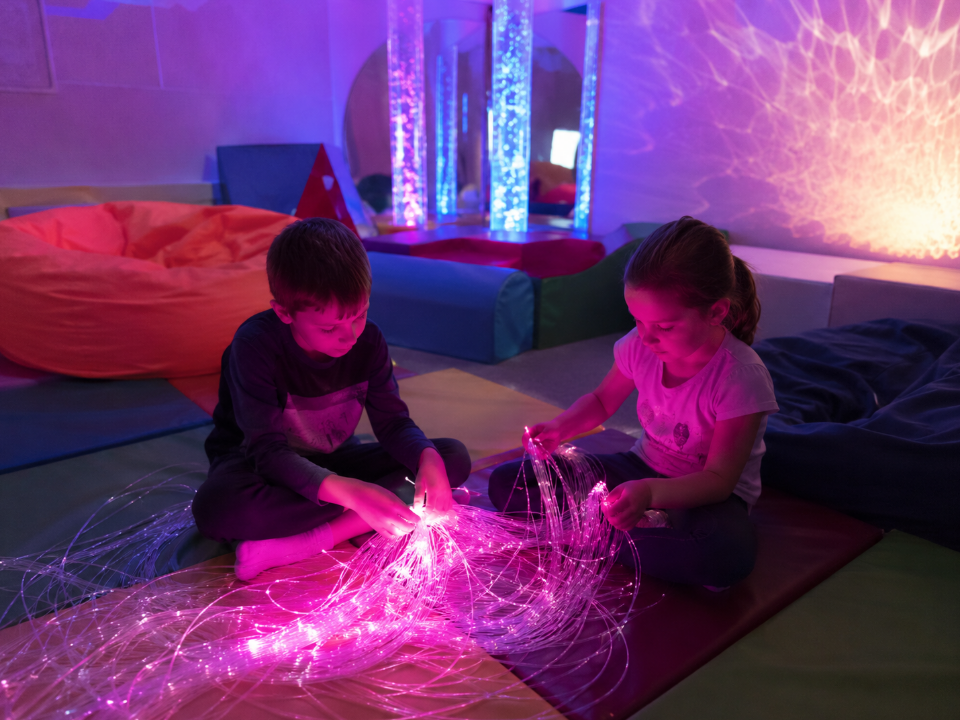
Multisensory environments, such as Snoezelen rooms, provide controlled sensory stimulation and have been studied as an intervention for autistic children.
A 2024 study examined the effects of an intervention involving controlled sensory stimulation on sensory behaviors in autistic children and reported some positive outcomes.
However, the evidence base remains limited, and further controlled studies are needed before firm conclusions can be drawn.
What the Evidence Does Not Support
It is important to note that many commonly used sensory interventions lack strong evidence.
Sensory diets, which are individualized schedules of activities intended to address sensory needs, weighted blankets, and other sensory products are widely used in practice, but the available high-quality evidence supporting them remains limited.
In summary, interventions should be individually tailored rather than presented as universally beneficial.
At the “Bishvil Hakochav” Center, as part of the developmental assessment provided to children and adolescents in individual sessions, a comprehensive evaluation of each person’s sensory profile is conducted when needed, followed by the development of a personalized intervention plan.
References:
Camino-Alarcón, J., Robles-Bello, M. A., Valencia-Naranjo, N., & Sarhani-Robles, A. (2024). A systematic review of treatment for children with autism spectrum disorder: The sensory processing and sensory integration approach. Children, 11(10), 1222.
De Domenico, C., Di Cara, M., Piccolo, A., Settimo, C., Leonardi, S., Giuffrè, G., ... & Cucinotta, F. (2024). Exploring the usefulness of a multi-sensory environment on sensory behaviors in children with autism spectrum disorder. Journal of Clinical Medicine, 13(14), 4162.
DuBois, D., Lymer, E., Gibson, B. E., Desarkar, P., & Nalder, E. (2017). Assessing sensory processing dysfunction in adults and adolescents with autism spectrum disorder: A scoping review. Brain sciences, 7(8), 108.
🟢 For all updates on autism and events at our center, join our quiet WhatsApp group 🟢


Comments